

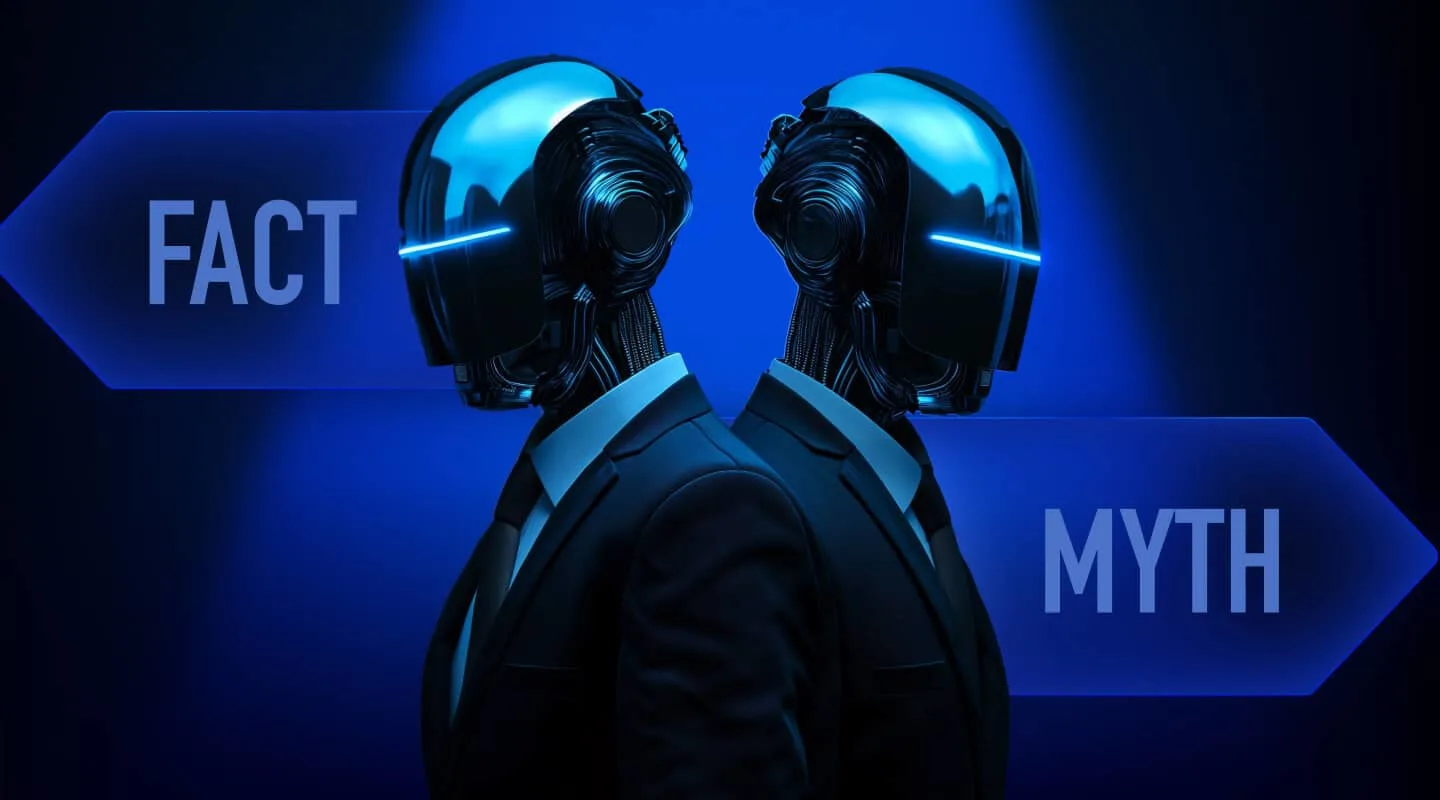
Artificial Intelligence (AI) provokes ambivalence, ranging from awe to fear. AI, to the rest of us, is an abstraction with myths and legends. De-mythologize AI, say what it really is—and isn’t—always, show real-world, practical applications, the raison d’être for this article. The reason is to illuminate, de-brief fears in a broad range of interested readers and teachers, too, without sacrificing technical reality to non-experts.
Debunking Popular AI Myths
- Myth 1: AI is Conscious and Thinks Like Humans
Reality: Present AI systems are not human-like in their thought process nor conscious. Though AI can execute specialized tasks based on pattern recognition and data analysis, there is no real understanding or capability to perceive itself. - Myth 2: AI Will Replace All Human Jobs
Reality: AI certainly automates routine work but also generates new jobs and makes people more efficient. The majority of the jobs are supplemented with the use of human-AI collaboration whereby computers do repetitive work so that humans have the strategic decision-making and creativity to implement. - Myth 3: AI Always Makes Perfect Decisions
Fact: AI learns from data, and where data is weak or biased, there may be mistakes and distorted conclusions. Transparency, good design, and constant checking are needed to make AI systems ethical and trustworthy. - Myth 4: AI Is Inherently Dangerous or Malevolent
Reality: Humans develop AI systems for their intended purpose. Ethical AI development, reduction of harm, and regulation reduce harm and maximise advantages.
What AI Actually Is
Artificial Intelligence is a name given to computer programs that do something which would otherwise be a function of human intelligence. Some of these include:
- Machine Learning: Programs learn from experience to recognize patterns and predict outcomes.
- Natural Language Processing: Helps to understand and generate human language (e.g., voice assistants, chatbots).
- Computer Vision: AI translates visual information (e.g., facial recognition).
- Robotics: AI gives machines physical movement abilities.
AI functions by analyzing large datasets, recognizing statistical patterns, and making decisions according to set rules or experience gained. AI is not human ability substitution but rather augmentation.
Application of AI in Everyday Life
- Personal Assistants: Siri, Alexa, and Google Assistant assist with scheduling, remembering appointments, and controlling smart home devices.
- Recommendations: AI is utilized by streaming services, online stores, and social media sites to offer personalized suggestions and recommendations.
- Healthcare: AI assists in disease diagnosis, treatment planning, and remote monitoring through wearable technology.
- Transportation: Navigation apps use AI to optimize routes and predict traffic; autonomous vehicle technology is advancing rapidly.
- Customer Service: AI-powered chatbots provide quick, around-the-clock responses to common inquiries, enhancing service availability.
- Fraud Detection: Banks and financial institutions use AI to detect abnormal patterns of behavior and stop fraud.
Beating Concerns
AI job replacement, loss of control, and privacy are real and assume the responsibility of responsible AI development:
- Privacy: Techniques used in AI application use data, but encryption, anonymization, federated learning, and regulation do not infringe on individual data.
- Work Impact: Examples of historical transitions in technology demonstrate flexibility to build new jobs, forge new skills, and innovate; policy and learning can be leveraged to maximize transitions.
- Control and Transparency: Explanations of goals for explainable AI to enable transparency into decisions so users and regulators have faith in AI outputs.
Conclusion
AI is not magic or horror. AI is a set of powerful technologies to break data and act independently on their own, thereby, streamlining things and unleashing innovation in spaces. To arrive at the actual substance of AI dispels myth and reveals utilitarian potential within grasp for everyone. By making educators and the people as a whole AI-literate, we are enabling informed debate and sanely legislated so that AI can be a force for good.
This short introduction raises suspicion—not of AI, but of misreporting—provoking interest on the basis of fact and fairness.
Technical precision and clarity are the objectives of this article in seeking to enlighten and reassure a general readership regarding the facts and potential of AI in daily life. I am happy to expand further on sections if needed or mold it to fit specific educational environments.