

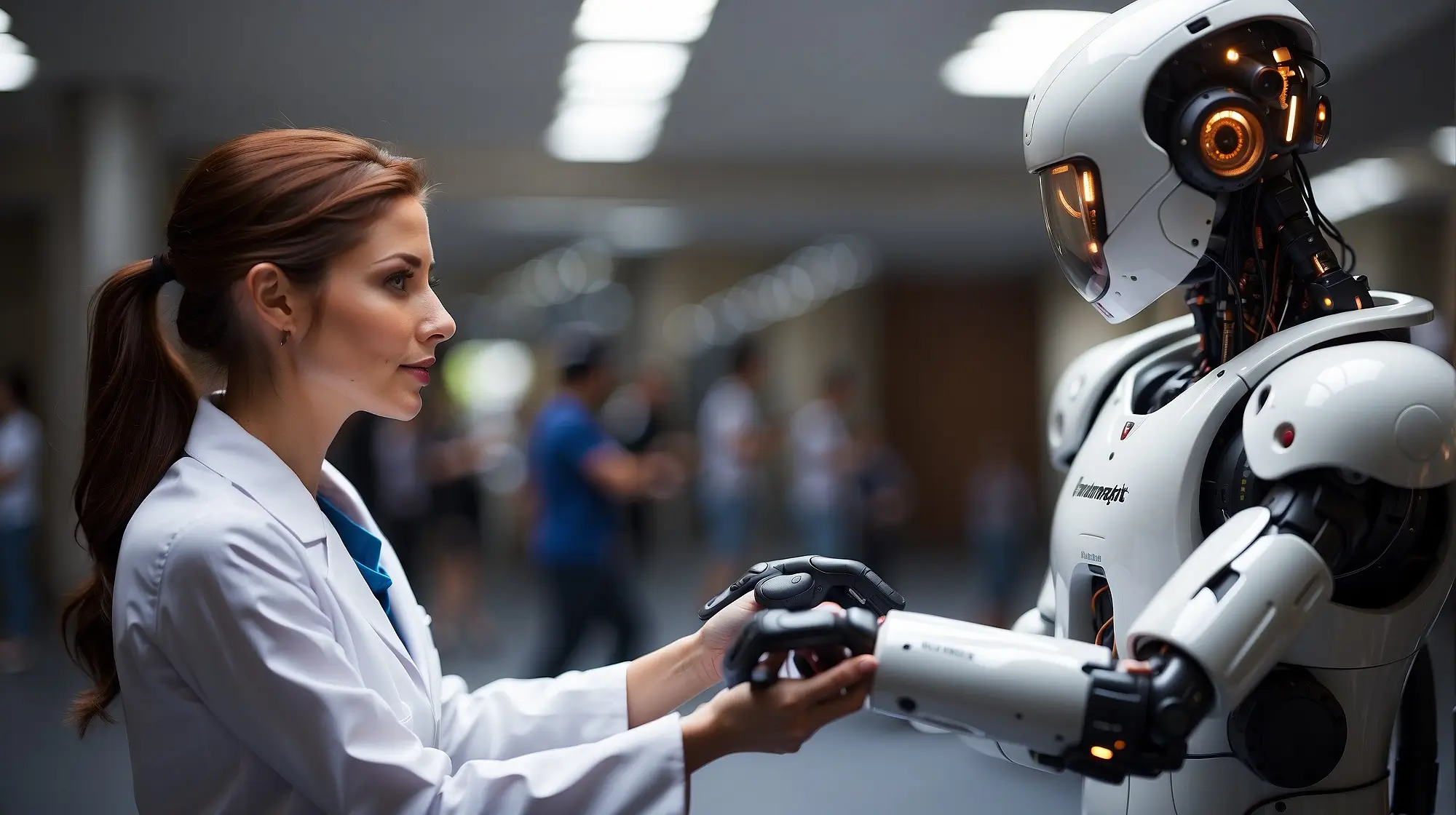
Human-AI Interaction (HAI) and intelligent robotics are converging technologies that are front-runners, transforming the human–machine interface in the workplace, domicile, healthcare, and public spaces. Between 2025, human engagement with clever robots is an interdisciplinary strategy integrating artificial intelligence, robotics, psychology, and human-computer interaction to open collaboration and collective advancement.
Understanding Human-AI Interaction
Human-AI Interaction studies the different types of human interaction with artificial beings from physical robots, virtual avatars, to conversational agents like chatbots. Embodiment and communications mode in such interaction differ:
- Physical Interaction: Humans engaging with robots and environments in tasks like healthcare assistance, therapy, or manufacturing. Physical interaction allows for non-verbal communication and direct manipulation but ought to avoid the “uncanny valley” effect where human-like appearance gives an uncomfortable sensation.
- Virtual Interaction: Autonomous virtual actors in virtual and mixed reality worlds, enabling interactive experiences in games, rehab, and collaborative remote work.
- Conversational Interaction: AI-driven natural language-based chatbots and voice assistants, offering services from customer support to tutoring education.
Critical analyses point out how areas of human brain responsible for social cognition respond to AI agents differently compared to human counterparts, affecting trust, interaction, and social bonding. Appearance, expressiveness, and perceived autonomy of robots determine whether the agents are regarded as tools, companions, or social peers. Emotionally intelligent AI that develops relative to states of users fosters acceptance and cooperation.
Intelligent Robotics and AI Integration
Intelligent robotics combines AI algorithms with computer vision, high-speed computation, and sensor technologies to create adaptive, autonomous robots. Intelligent robots:
- Navigate through vague, uncertain environments using vast sensory data.
- Enhance operations through AI-based simulation and actual experience learning.
- Facilitate industry (manufacturing, logistics), health (assistive robots), and sustainability (precision agriculture, green energy).
Amongst the most powerful trends of 2025 is building humanoid robots as the universal-purpose machine, along with specialty robots for a specific industrial or service application. Physical AI, simulation-trained robots in order to learn operational skills, gives capability and agility without draining programming.
Robotics also plays a great role towards sustainability goals by improving manufacturing precision, reducing waste, and maximizing energy efficiency.
Psychological and Social Dimensions
Recent research transposes psychological theory such as attachment theory to human-AI relations and finds that users can exhibit attachment-style behavior toward AI from emotional reassurance seeking to emotional distance seeking. Such findings enable personalized AI design that is even more sensitive to the user’s emotional and cognitive requirements and facilitates trust and efficacy.
Future Challenges and Directions
Even while development has been in a hurry, there are challenges:
- Avoid the uncanny valley to ensure robot acceptance.
- Giving AI explainability and transparency of autonomous choice.
- Balancing ethical consideration on privacy, autonomy, and social influence.
- Empowering adaptive AI that executes on heterogeneous hardware and diverse human preferences.
- Synchronizing automation with effective human control and accountability.
In coming years, the man-AI-robotic ecosystem will become ever more symbiotic in intelligent working environments, healthcare, education, and daily life. Advances in multimodal interaction (speech, gestures, and facial expressions), augmented reality interfaces, and affective AI will progressively remove borders between man and machines.
Finally, it’s not so much a matter of technology as it is assembling powerful partnerships to increase human capacity, creativity, and happiness—enabling humans and AI-based robots to live and work on an equal basis in the future.
This review journal consolidates the latest 2025 studies and conferences on human-AI interaction and intelligent robots, technical, psychological, and social knowledge as it affects researchers, practitioners, and policy makers.
[1] https://humanrobotinteraction.org/2025/
[2] https://sites.google.com/view/mipr-2025/innovation-forums/ai-humans-and-robotics-shaping-the-future-of-intelligent-collaboration
[3] https://www.frontiersin.org/journals/psychology/articles/10.3389/fpsyg.2025.1569277/full
[4] https://ifr.org/ifr-press-releases/news/top-5-global-robotics-trends-2025
[5] https://pal-robotics.com/event/hri-2025/
[6] https://www.iros25.org
[7] https://link.springer.com/article/10.1007/s12144-025-07917-6
[8] https://www.artinhci.com
[9] https://www.sciencedirect.com/science/article/pii/S2543925124000147
[10] https://www.imaging.org/IST/IST/Conferences/EI/EI2025/Conference/C_IRIACV.aspx
[11] https://icsr2025.eu
[12] https://brambilla.faculty.polimi.it/2025/02/unveiling-human-ai-interaction-and-subjective-perceptions-about-artificial-intelligent-agents/
[13] https://www.springer.com/book/9789819521005
[14] https://nocworkshop.github.io/2025/
[15] https://www.nature.com/articles/s41746-025-01559-5
[16] https://www.icira2025.com
[17] https://www.santannapisa.it/en/airone-artificial-intelligence-and-robotics-extended-reality-24-25
[18] https://pubsonline.informs.org/doi/10.1287/mnsc.2022.03849
[19] https://easychair.org/cfp/IntRob25
[20] https://www.dis.cwi.nl/research-areas/trustworthy-human-ai-interaction