

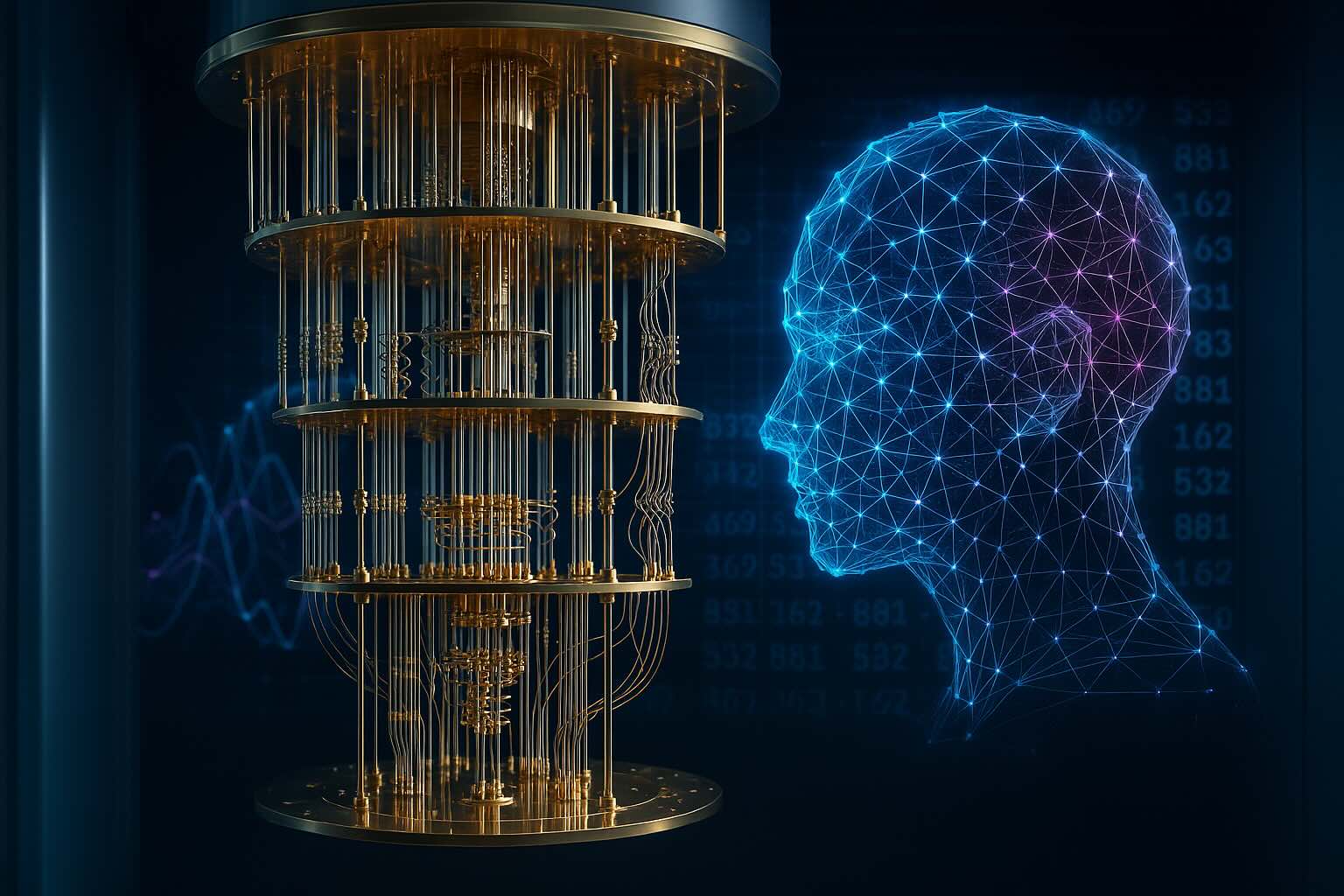
Quantum Machine Learning (QML) represents a promising convergence of two emerging technologies: artificial intelligence (AI) and quantum computing. In 2025, the emerging discipline employs quantum computational machines to improve machine learning algorithms to augment abilities beyond regular computers for managing complicated data, optimizing models, and solving problems where they falter.
What is Quantum Machine Learning?
Quantum machine learning applies quantum algorithms and conventional ML techniques. Quantum computers use the quantum mechanical phenomena of entanglement and superposition to compute high-dimensional data sets at large scales more efficiently compared to classical machines. Hybrid approaches today combine conventional pre-processing and optimisation with accelerating the heavy computation by matrix operations and pattern recognition using quantum processors.
This collaboration allows QML to tackle intricate issues in areas other than what is achievable by conventional AI, including drug discovery, cyber-security, modeling of the climate, and intelligent transport.
Applications and Advances in 2025
- Drug Discovery and Materials Science: Quantum computers simulate molecular interactions at a quantum level, thereby allowing new materials and new drugs to be engineered with greater precision and velocity. SpinQ companies utilize QML to customize genomic sequencing and molecular design in order to drive biomedical innovation faster.
- Cybersecurity: QML is utilized to search for complex patterns in cybersecurity data in order to enhance threat identification and response.
- Optimization Problems: Portfolio management, supply chain planning, and resource planning in finance and logistics are optimized better by QML.
- Environmental Modeling: Climate and energy system modeling is optimized better with the help of QML methods in terms of sustainability and renewable resource management.
These developments expose the revolutionary potential of QML far beyond promise at the theoretical level as useful applications spread through research and industrial spheres.
Challenges and Future Directions
Despite developments, problems like decoherence and noise in current quantum hardware, limits on scalability, and circuit design that decidedly outdo their classical counterparts are still in place. Quantum neural networks, variational circuits, and quantum kernel methods are all research streams aiming to resolve these challenges.
Short-term, the coming decade will see incremental progress from concept-proof QML models to organizational deployments as quantum hardware matures. A 2025–2035 roadmap speculates on future breakthroughs in supervised QML approaches, combined frameworks, and increased deployment in applied research and corporate settings.
Conclusion
Quantum machine learning represents the newest frontier in artificial intelligence as an emerging new opportunity through the intersection of the capability of quantum computing with advanced learning algorithms. QML 2025 is coming out of experimental into application stages, which is leading innovation in drug discovery, cyber security, green science, and more.
With technology hurdles overcome and quantum-classical hybrids optimized, QML may redefine the frontiers of AI capability — accelerating discovery, optimizing intricate systems, and transforming industries in a matter of years.