

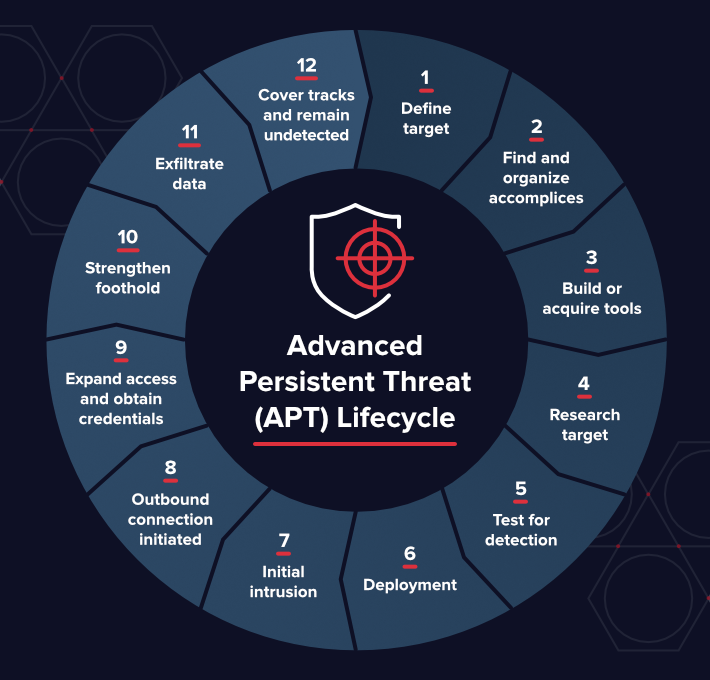
APTs will be the most sophisticated and insidious cyberattacks on businesses in 2025. APTs are sophisticated, persistent, and stealthy. APTs will attempt to breach systems in an effort to steal intellectual property or cause disruption for months or years without anyone even realizing it.
Anatomy of APTs
Finances Targeted and Accounted For: Nation-state or cybercrime threat actors utilize APT to target valuable assets such as governments, critical infrastructure, and high-value intellectual property owners.
- Sophisticated Techniques: Threat actors gain unauthorized system access to begin with zero-day exploit vulnerabilities, tailored malware, fileless attacks, social engineering, and spear-phishing. Backdoors, scheduled tasks, and evasive user accounts are also utilized for persistence.
- Multi-Phase Lifecycle: APT attack is carried out in numerous phases: gathering of reconnaissance intelligence, first compromise, network mobility, privilege escalation, data stealing, and eventually achieving persistence for attacking later.
- Stealth and Adaptability: APT attackers employ encryption, polymorphic malware, and legitimate credentials with the hope that it won’t get discovered and go stealthy and sidestep standard security controls.
- Threat Intelligence and Monitoring: AI-based detection or AI cameras monitor all the time for APT attack activity typical behaviors.
- Network Segmentation and Zero Trust: Network segmentation avoids lateral movement and zero trust policy grants access regardless of user locations.
- Endpoint Detection and Response (EDR): Endpoint behavior is delivered by EDR technologies with visibility to all endpoints, providing first sight on malicious activity.
- Systematic Patch Management: Deployed software patches vulnerabilities that are being exploited by attackers.
- End User Security Awareness Training and Simulated Phishing: End users trained on social engineering-attack methods make such techniques useless.
- Incident Response Planning: Playbook-driven preemption and centrally centralized incident response teams support quick containment and remediation.
Conclusion
APTs are covert, extended-duration, value-based avoidance cyber security threat. Organizations must embrace a converged, multi-layered threat intelligence-led network segmentation, zero trust, and next-generation detection platform. End-user training, incident response, and patching can make a said controls the number one priority for shutting the next APT window of vulnerability of 2025 and onward.