

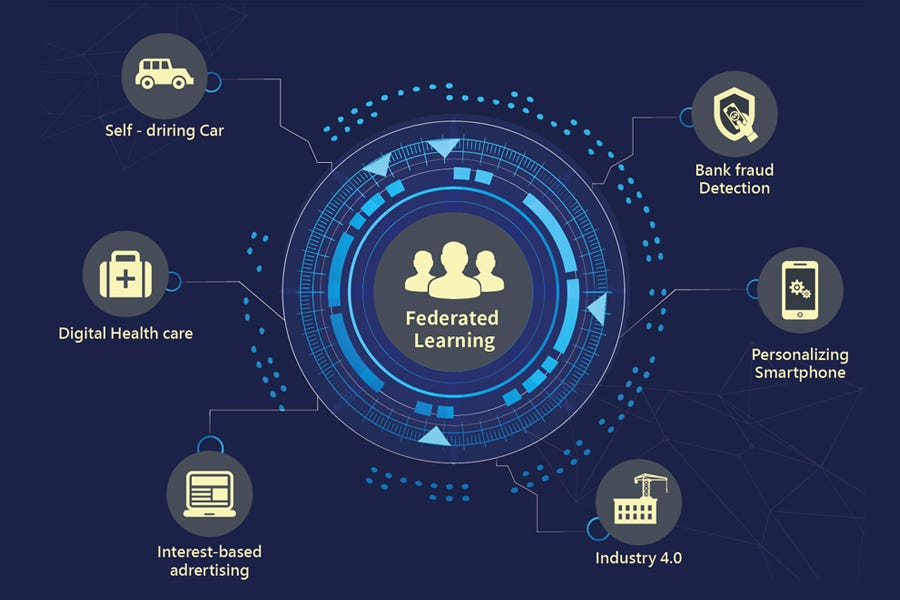
Credit risk prediction is the cornerstone of contemporary banking, as it allows banks to predict the probability of default by lenders on loans. Conventional credit risk models are based on having access to extensive and varied data sets. Despite this, data sharing between banks involving sensitive financial details poses significant privacy, security, and regulatory issues. Modern development has witnessed the rise of Federated Learning (FL) as an innovative framework where multiple banks are able to jointly create credit risk models without actually sharing raw data, thereby preserving confidentiality.
What is Federated Learning?
Federated Learning is a distributed machine learning system in which local parties (banks in this instance) learn local models on local data and send only the learned model parameters—not the data the model was learned from—to a central server. The server aggregates these updates to calculate a global model with sensitive customer data hidden and in compliance with data protection legislation.
Overcoming the Challenges of Credit Risk Modeling
Credit risk modeling is faced with heterogeneity of data across banks, Non-IID data, and regulatory demands. Federated Learning credit risk architectures specifically intended for credit risk come with strong aggregation algorithms and fully integrated feature fusion mechanisms that reconcile conflicting sources of data and enhance model accuracy despite these challenges.
Benefit of Using FL to Multi-Bank Setting
- Protection of Privacy: Customer data is never communicated from the secure domain of the bank, reducing exposure to data loss as well as compliance with stringent laws like GDPR.
- Increased Model Accuracy: Due to collective learning from each other’s experience across multiple banks, the global model generalizes and predicts more precisely compared to individual models.
- Scalability and Flexibility: FL makes it possible to provide decentralized computing for scalable participation of increasingly more banks without the clogging of central infrastructure.
- Compliance Regulation: Encourages compliance with the law by restricting information sharing and making collaboration easier in managing risk.
Recent Developments and Case Studies
Experiments show that FL architectures, even in decentralized case, achieve 71% to 99% accuracy in credit risk prediction and outperform the traditional approach particularly on heterogeneous data sets. Techniques such as Federated Averaging improve training stability. Real-world deployments in financial settings realize promising results in operation efficiency with reasonable communication load and secure model update.
Innovations in technology include dynamic adaptive receptive field to facilitate feature extraction and advanced feature fusion methods that minimize communication expenses and provide high-quality predictions. The innovations allow for the utilization of increased FL adoption to attain comprehensive financial risk modeling.
Future Directions
FEDERATED learning for credit risk assessment will become increasingly demanded as banks seek cooperative but trusted AI systems. Work is ongoing to improve model robustness, improve adversarial defense, and include explainable AI techniques to meet regulators’ and stakeholders’ needs for transparency.
Conclusion
Federated Learning brings paradigm shift in multi-bank credit risk analysis via balancing data privacy and collective intelligence. The privacy-safeguarding model enhances default prediction effectiveness, compliance with regulations, and scaling business operations. As more financial institutions embrace FL, it ensures safer, better, and innovative credit risk management in the digital economy.
This article combines state-of-the-art research contributions and real success of using federated learning to predict credit risk in various banks with emphasis on privacy protection as well as collaborative model improvement.