

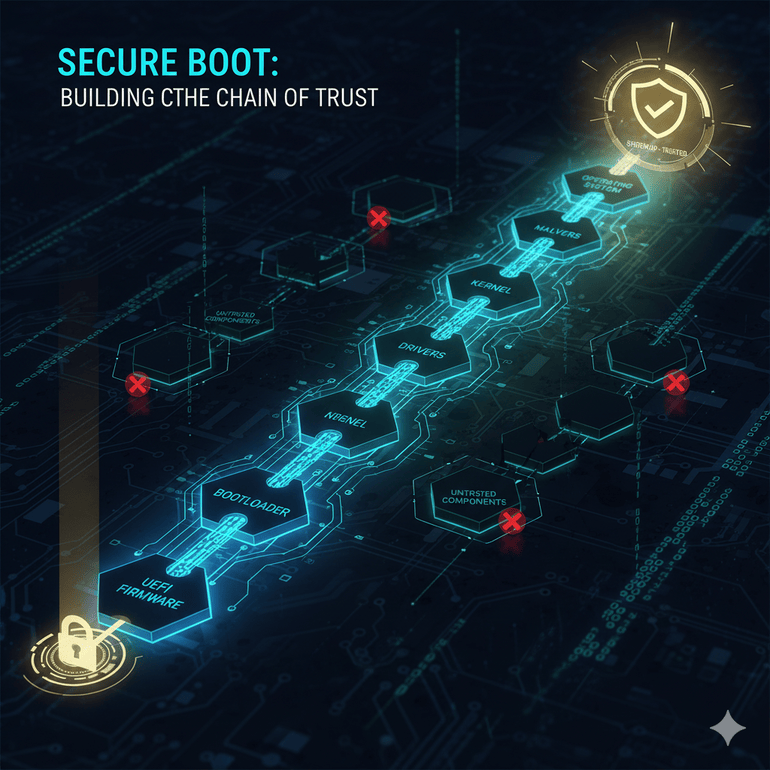
Secure Boot and Measured Boot are both strong mechanisms utilized to enhance computing platform security by cryptographically verifying the integrity of the entire software load before boot-up. They permit just the trusted parts of the software—i.e., bootloader, kernel, and OS—to execute, excluding unauthorized or malware code from establishing grip on the system during boot-up.
Secure Boot: Building a Chain of Trust
Secure Boot is based on a chain of trust that begins with device firmware (usually UEFI). Secure Boot verifies the digital signature of each stage of the boot process when booting up a device. It verifies for each byte of code whether it’s been corrupted and if signed by a trusted signer. If event validation fails at any step, booting is stopped, protecting the system from rootkits and bootkits—those bits of malware that infect the system boot deeply.
Measured Boot: Integrity Capture and Reporting
Secure Boot does not allow untrusted code to run, while Measured Boot targets capturing the integrity state of the boot process and device in general and reporting it to a remote trusted device. Measured Boot utilizes a TPM hardware component that cryptographically hashes firmware, bootloader, operating system kernel, and other vital components securely at load time.
This is what Measured Boot actually does:
- During boot time, UEFI firmware calculates cryptographic hashes of the firmware and of boot components and stores them within the TPM.
- Near the conclusion of boot time, a remote attestation client of an OS uses the TPM to calculate a signed record of these measurements.
- It forwards this log to a trusted attestation server that verifies the measurements against known good values.
- The server can, with this check, decide if the device is not tampered with and in good health or not, according access to the network or resources as necessary, i.e., full or limited network access.
Role in Current Security Systems
Secure Boot and Measured Boot are the pillars that reduce the risk of long-lived firmware and boot-level malware by essentially eliminating it. It is not only essential for desktop and server security but also in the cloud, Internet of Things (IoT) devices, and mission-critical infrastructure.
But these protections are based on correct use and must be invoked along with other protections because memory corruption bugs lie in wait to be invoked once boot verification has succeeded.
Conclusion
Secure Boot and Measured Boot protect device boot time from tampering both by cryptographically verifying and checking the integrity of every stage of software load before operating system execution. Secure Boot protects against code-type attacks, and Measured Boot notifies remote trusted parties of system health. Both are fundamental components of a rebuilt, trusted computing base resistant to advanced persistent threats and device integrity in cloud and distributed environments.
Further technical information, implementation contexts, or enterprise security architecture examples can be made available on request.