

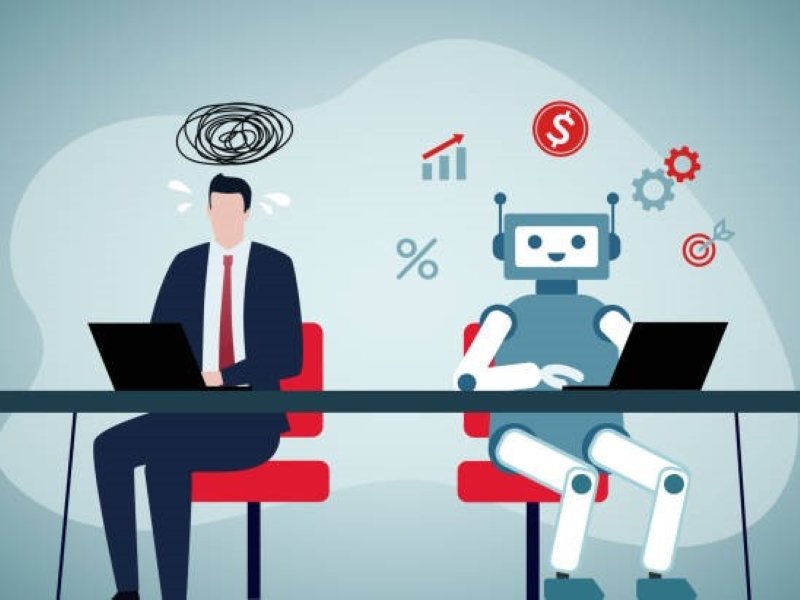
2025 declares augmented machine learning (AML) as a revolutionary concept, facilitating human-artificial intelligence (AI) collaboration. AML is distinct from complete autonomous AI to the point where it aims to complement human intelligence by combining humans’ and machines’ greatest strengths to reinforce decision-making, productivity, and innovation in all industries.
What is Augmented Machine Learning?
Augmented machine learning is utilized to define AI solutions that do not aim to replace human beings but aid them, showing results, giving recommendations, and doing mechanical work while human beings stay “in the loop” to make the important decisions. People-first approach employs machine learning (ML), natural language processing (NLP), and data augmentation techniques to decompose complex data analysis into easy-to-see, easy-to-action results that can be simply understood by human beings with or without expert knowledge.
AML differs from traditional ML in its approach to utilizing cooperation and transparency to allow users to see, read, and regulate AI output, limiting trust and explainability challenges.
Primary AML Benefits in 2025
- Improved Decision-Making: AML applications digest enormous data in mere minutes, identify patterns, and offer suggestions that allow experts to make informed decisions in finance, healthcare, and marketing.
- Enhanced Productivity: Automated tasks such as model training and data cleaning free up human experts to focus on strategy, innovation, and context-based decision-making.
- Enhanced Accessibility: Technical stakeholders are now able to write data queries and use AI reports in natural language through NLP interfaces, hence democratizing analytics in organizations.
- Interactive Learning: Human interactions induce AML models to learn, update their models, and react to novel situations less likely to be biased or erroneous.
Applications Facilitating Human-AI Collaboration
Areas more and more leverage AML to deal with complex problems:
- Medicine: Doctors employ AI-powered diagnostics that identify potential diseases, enabling it to assess patients better and quicker.
- Finance: Professionals use AML to forecast market trends, minimize risks, and maximize portfolios while retaining final decision-making power.
- E-commerce and Retail: Sellers apply AML for predictive demand, segmentation-based marketing, and fraud detection, with benefits of enhanced customer experience and enhanced operational efficiency.
- Supply Chain: AML assists in real-time monitoring, anomaly identification, and predictive maintenance, with the benefit of increased resilience and cost savings.
Challenges and Future Directions
In order to unlock AML’s potential, issues of data privacy, model explainability, and integration with existing workflows need to be solved. AI ethical design for transparency and fairness is most critical in order to build trust and adoption.
Today’s research is shifting towards more explainable AI (XAI) approaches, adaptive learning models, and AML application extensions to other domains. Expanded human-AI cooperation is anticipated, where AML systems serve as intelligent assistants to complement human imagination and intelligence.
Conclusion
Augmented machine learning represents a move towards human-centered AI to cooperate and obtain higher insights, efficiency, and innovation. Augmenting control through humans while leveraging the computational abilities of AI, AML shuts the loop between complex data and actionable knowledge.
By 2025, AML is changing industries by empowering users, informing decision-making, and democratizing AI power—enabling a new epoch of productive human-AI partnership that will be necessary to address the complex challenges of today.