
While machine learning (ML) technologies are steadily penetrating major industries—spanning health care and finance to criminal justice and hiring—ensuring these models are unbiased and nondiscriminatory is of the highest priority. Unbalanced machine learning has the potential to instill unfair discrimination against specific sets of individuals, upholding society’s prejudice. In 2025, strong detection and mitigation are needed to develop balanced AI systems that are able to win user confidence and meet ethical standards.
Sources and Forms of Bias
The cause of bias may be non-representative training data, incorrect labels, learned biases, or feature bias. Some examples include demographic bias (gender, ethnicity), sample selection bias, and algorithmic bias, with models favoring or belittling certain groups repeatedly.
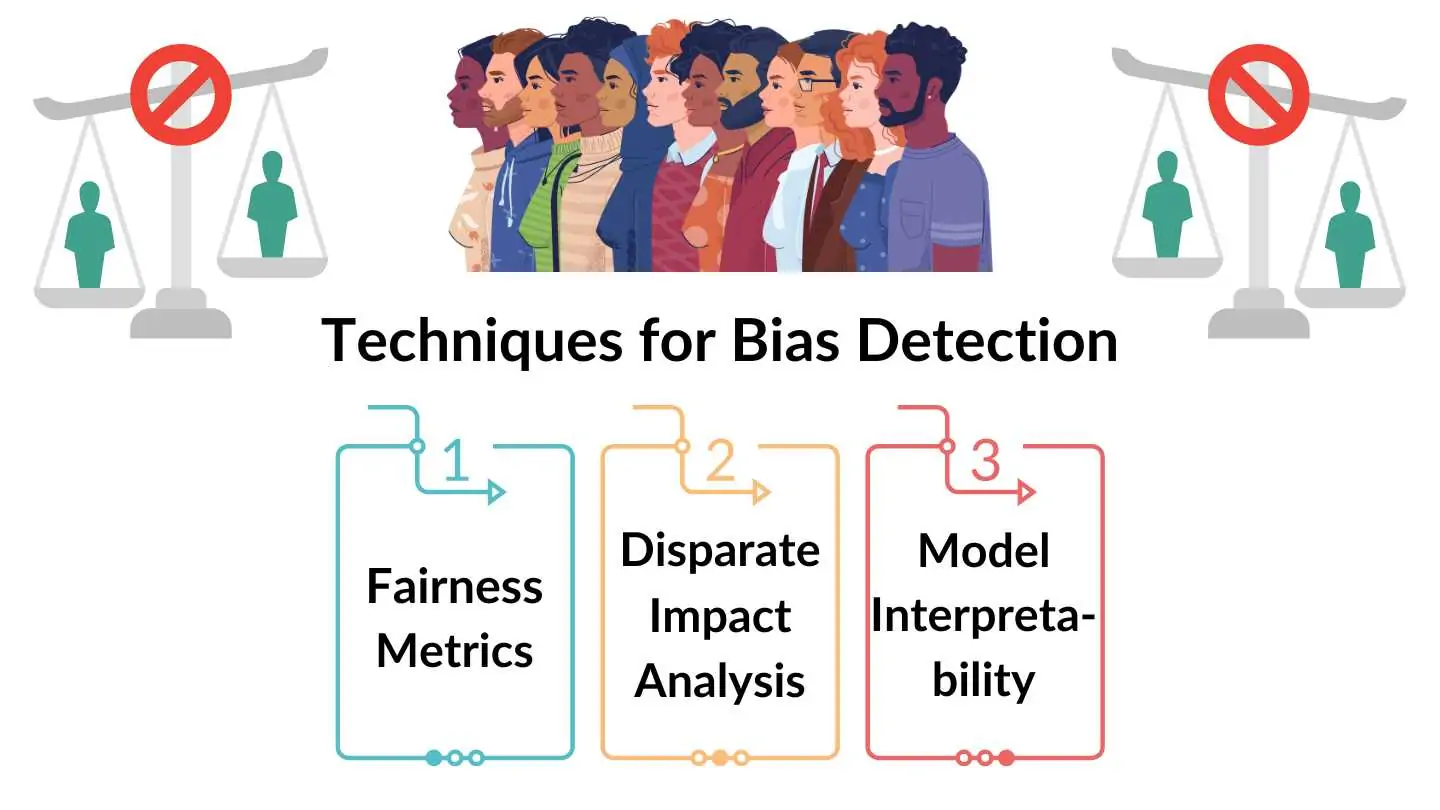
Methods of Detecting Bias
New technologies combine statistical, algorithmic, and human methods:
- Statistical Metrics: Demographic parity, equal opportunity, and equalized odds are fairness metrics for group disparity between protected groups in model predictions.
- Human-in-the-Loop Auditing: New perception-based paradigms depend on human instinct to identify minor biasing based on visualized cluster and decision boundary in data, even with limited label abundance.
- Model Evaluation Protocols: Split-and-cross evaluation techniques assess model performance across many subgroups and test generalizability across populations.
- Explainable AI Tools: Google’s What-If Tool and Microsoft Fairlearn facilitate interactive exploration of feature importance and counterfactual fairness situations.
Mitigating bias involves interventions at various stages:
- Pre-processing: Re-weighting of the data, sample synthesis, and transformation of features to balance datasets.
- In-processing: Optimization subject to fairness constraints, adversarial debiasing, and regularization-based fair learning goals during model training.
- Post-processing: Calibration of model outputs and thresholding to satisfy fairness constraints without re-training.
Emerging Tools and Integration
Cloud providers now provide bias detection and mitigation as part of CI/CD pipelines to automate fairness checks before deployment. Real-time monitoring solutions for bias issue notifications on fairness breaches after deployment.
Conclusion
Bias and fairness in machine learning are dynamic, high-dimensional challenges requiring an end-to-end solution. Advanced detection methods combine human judgement and algorithmic rigour, and high-dimensional mitigation methods offset bias throughout the ML lifecycle.
As 2025 approaches, development teams must make fairness a guiding principle—to use tools, frameworks, and ethical principles—to build machine learning models that generate fair outputs, trust society, and prevent scaled risks of discrimination.