

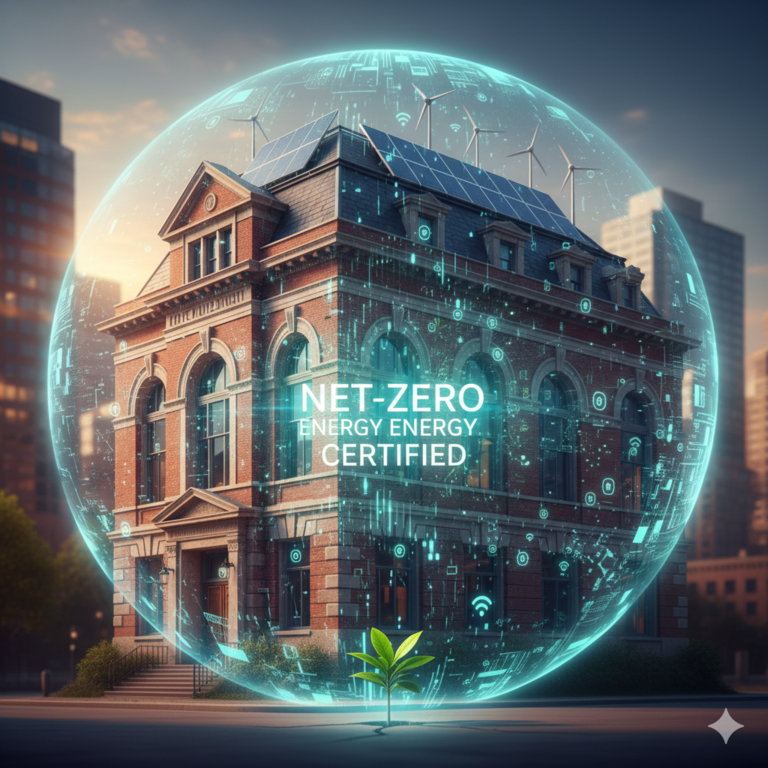
We often think of “green buildings” as futuristic glass towers rising in Dubai or Singapore. But the real battle for our planet’s future isn’t being fought in new construction—it’s being fought in the drafty, aging offices and apartment blocks we already have.
In 2026, the most exciting trend in real estate isn’t building new; it’s the IoT Retrofit. It’s the process of taking a “dumb” 40-year-old building and giving it a digital brain to achieve a Net-Zero Energy Certification.
The Problem: The Energy Leaks We Can’t See
Traditional buildings are incredibly wasteful. They heat rooms that are empty, blast air conditioning on cool mornings, and keep lights on in hallways where no one walks. Historically, fixing this meant expensive, invasive renovations—tearing out walls and replacing entire HVAC systems.
IoT (the Internet of Things) has changed the game. Instead of surgery, we’re giving these buildings a nervous system.
The Digital Nervous System
A Net-Zero retrofit starts with thousands of tiny, wireless sensors. These aren’t just thermometers; they are the “eyes and ears” of the structure.
- Occupancy Sensors: They know exactly how many people are in a conference room. If two people leave, the system throttles back the fresh air intake to save energy.
- Light-Harvesting: Smart windows adjust their tint based on the sun’s position, reducing the need for electric cooling while maximizing natural light.
- Predictive Maintenance: Sensors on old water pumps detect vibrations that a human wouldn’t notice. By fixing a struggling pump before it fails, the building avoids massive energy spikes.
The “Brain” in the Cloud
All this data flows into a central platform—the building’s brain. Using AI, the building begins to learn its own habits. It looks at the weather forecast for tomorrow and “pre-cools” the structure at 4:00 AM when electricity is cheap and the air is cold, so it doesn’t have to work as hard when the sun hits at noon.
When a building produces as much energy (usually via solar panels or geothermal) as it consumes over a year, it hits that holy grail: Net-Zero Certification.
Why This Feels Different
The most human part of this technology is how it changes our experience inside. Net-Zero retrofits aren’t just about saving the planet; they are about comfort. Because the system is so precise, you no longer have “the frozen corner” of the office or the “sweltering lobby.” The building breathes with its occupants.
Furthermore, it’s democratizing sustainability. Small business owners who can’t afford a new headquarters can now buy a box of sensors, stick them to their walls, and watch their carbon footprint—and their utility bills—vanish.
Final Thoughts
We can’t build our way out of the climate crisis with new concrete alone. The greenest building is the one that already exists. By “retrofitting” our history with modern IoT intelligence, we are proving that even the oldest structures can be part of a net-zero future.