

Introduction
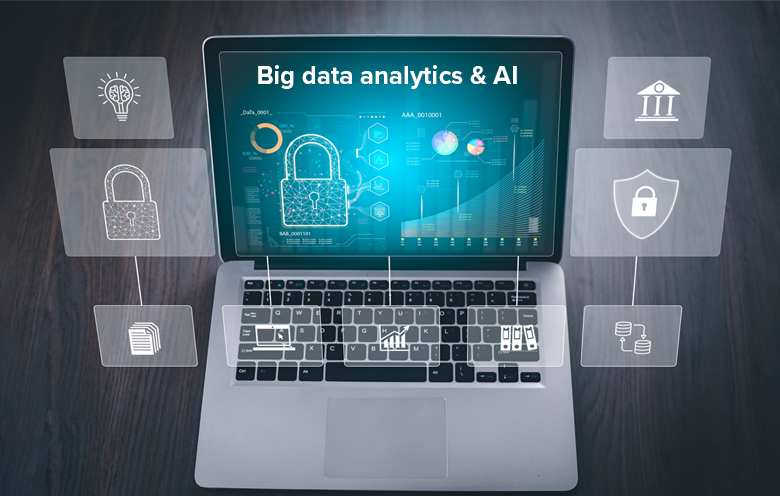
With the arrival of the digital era, cybersecurity threats are burgeoning at a pace never seen in history. Data breaches, privacy violations, and cyberattacks are becoming more and more sophisticated, with traditional security measures proving inadequate. Artificial Intelligence (AI) and Big Data Analytics are emerging as fast-track technologies to enhance Information and Communication Technology (ICT) security and safeguard data privacy. This journal explores how these technologies are revolutionizing cybersecurity and the array of challenges they present.
The Role of AI in ICT Security
AI, especially machine learning (ML) and deep learning, is transforming cybersecurity through proactive threat detection and response. Some of the main applications include:
Threat Detection & Anomaly Detection
- AI-based systems scan network traffic patterns to identify abnormal activity that can be a sign of a cyberattack (e.g., intrusion detection systems).
- Machine learning programs can identify zero-day exploits through the identification of anomalies from normal activity. Automated Incident Response
- AI automatically responds to security incidents by isolating infected systems, blocking malicious IPs, or applying patches.
- Security Orchestration, Automation, and Response (SOAR) solutions leverage AI to automate incident response.
Phishing & Fraud Prevention - Natural Language Processing (NLP) aids in phishing email detection using language pattern and sender behavior.
- AI-driven authentication systems (e.g., behavioral biometrics) enhance identity verification.
Big Data Analytics for Improved Security
Big Data Analytics processes vast quantities of security logs, transaction information, and user behavior data to identify previously unknown threats. Key contributions include:
Predictive Cyber Threat Analytics
- Through examination of past attacks, predictive models can predict future vulnerabilities and attack surfaces.
Real-time Monitoring & Log Analysis
- Big Data is used by Security Information and Event Management (SIEM) systems to aggregate events from multiple sources for correlated analysis to identify coordinated attacks. **Privacy-Preserving Data Analytics
- Techniques like differential privacy and homomorphic encryption enable one to analyze data without disclosing sensitive information.
Challenges and Ethical Issues
While AI and Big Data are full of promise, they pose challenges as well:
False Positives & Bias in AI Models
- Over-reliance on AI may result in incorrect categorizations of threats when training data is biased.
Data Privacy Issues
- Collecting large data sets to be analyzed raises privacy issues, with the requirements to comply with regulations like GDPR and CCPA. Adversarial AI Attacks
- AI algorithms can be compromised (e.g., adversarial machine learning) to bypass security measures.
Future Directions
- Explainable AI (XAI) for clear decision-making in cybersecurity.
- Federated Learning to train AI models over decentralized but not shared data, for preserving privacy.
- Quantum-Resistant Encryption in order to future-proof cyber attacks.
Conclusion
Big Data Analytics and AI are transforming ICT security through enabling faster, smarter, and more astute defenses. Their integration, however, must be balanced against ethical requirements to render the security robust while not compromising privacy. With cyber attacks growing more sophisticated by the day, continuous innovations in these technologies will be essential in safeguarding digital environments.
Reflection:
Reading about the intersection of AI, Big Data, and cybersecurity has made me understand more profoundly how technology is able to protect against and unintentionally create threats. Interdisciplinary collaboration will be most critical in developing secure and privacy-conscious solutions in the future.