

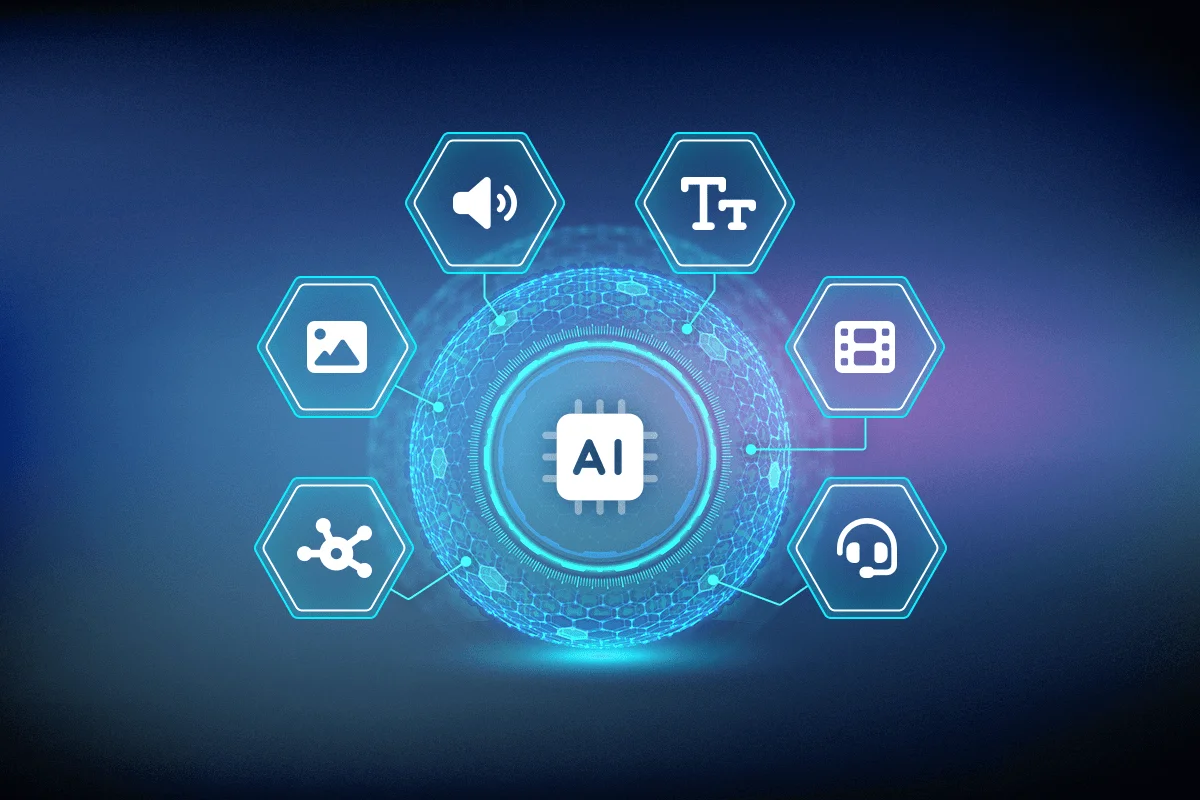
Artificial intelligence technology hit a breaking point in 2025 when multimodal AI models were developed. New models integrate several modes of information—language, vision, and sound—into more natural, intuitive, and efficient human-computer interfaces. In contrast to the classical AI models, which excel at one modality but are atrocious at others, multimodal AI integrates diverse sensory inputs in an attempt to learn and act upon complex real-world scenarios.
The Foundation Stone for Multimodal AI
Multimodal AI applications take advantage of deep learning technologies that ingest and output text, image, video, and audio information simultaneously. The combined inputs allow AI to understand meaning, context meaning, and emotional tones and vomit out responses almost as good as human intelligence and empathy.
For example, a multimodal AI may accept voice commands (speech, audio), face recognition (vision, sight), as well as understand contextual text (text) simultaneously. This consolidation contributes to the precision of understanding, especially in noisy or uncertain settings.
Applications Driving Transformation
In medical practice, multimodal AI allows diagnosis of the integration of radiology images, clinician response, and patient voice patterns to be appropriately analyzed. It allows telemedicine by enabling real-time analysis of patient sentiment and symptoms to improve the quality of the remote practice.
In learning, the models push adaptive learning spaces responsive not just to student-written responses but also to gesturing, facial expression, and voice, allowing for greater interactivity and improved outcomes.
Multimodal AI is applied in consumer software such as home automation controllers and cellular telephones to provide fluid, context-dependent interaction. For instance, smart appliances can infer smart commands from tone of voice and visual data in conjunctive combination, easy for the disabled.
Challenges and Opportunities
Successful multimodal AI generation needs to address modality data alignment issues, requirements of computational augmentation, and reducing bias in model training. Ethical trade-offs of privacy, consent, and transparency become greater with higher volumes of sensitive sensor data collected with AI.
Even more innovations such as self-supervised learning and better model design, however, are being built with a more breakneck speed and being deployed and scaled more and more readily.
The Future of Human-Machine Interaction
Multimodal AI systems are the zenith of emotionalizing AI, making it more contextualized and adaptable by 2025. Multimodal AI systems see the future of technology that not only comprehends words but the entire human experience—a stepping stone to genuine intelligent digital friends, companions, and assistants.
Multimodal vision, speech, and language AI models as a whole are revolutionizing next-generation human-machine interaction. Separately and in combination, they have the capability to make AI read and react to more subtle inputs more human-like, giving rise to revolutionary application fields from consumer electronics and education to medicine. With ongoing research and advancements in technology, the models will drive human-machine symbiosis to newer and newer heights in more natural and more substantial ways.