

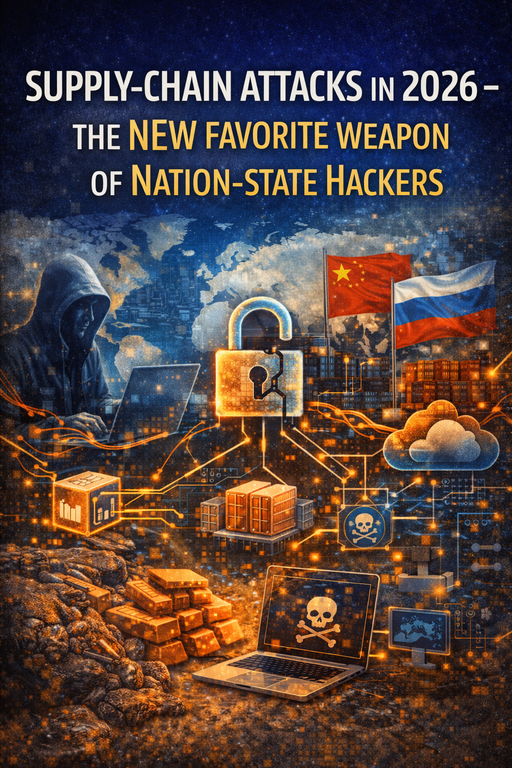
In 2026, the world of cyber warfare has officially moved away from the “front door.” If you’re a nation-state hacker, you don’t waste months trying to kick down the reinforced gates of a central bank or a government agency. Instead, you go after the people they trust: their software providers, their cloud services, or even the small company that manages their printers.
This is the era of the Supply-Chain Attack, and it has become the ultimate “Trojan Horse” of the digital age.
The Power of “Borrowed” Trust
The reason these attacks are so devastatingly effective is simple: they weaponize trust. Every business on the planet relies on a massive web of third-party tools to stay afloat. When a hacker poisons a single software update from a trusted vendor, they aren’t just hitting one target—they are hitching a ride into the servers of every single one of that vendor’s customers.
For a nation-state, this is a dream scenario. It offers:
- Invisible Entry: The malicious code arrives through a “legal” update. Your computer thinks it’s just getting a routine patch.
- Massive Reach: Break into one provider, and you suddenly have access to thousands of companies across entire industries.
- The Long Game: Because the entry looks legitimate, these “digital spies” can sit quietly in a system for years, watching, learning, and waiting for the right moment to strike.
From Spying to Sabotage
In 2026, we’ve seen a shift in why these attacks happen. It’s no longer just about stealing secrets or corporate emails. Nation-states are using these backdoors to gain a foothold in critical infrastructure.
We’re talking about the systems that control our power grids, water supplies, and hospitals. By burying “sleeper” code in the supply chain today, an adversary can effectively prepare a “cyber-battlefield” for a conflict that might not even happen for years. It’s the digital equivalent of mining a harbor during peacetime.
The New Targets: It’s Not Just Software Anymore
Hackers are getting creative. While they still love a good software breach, they’ve expanded their horizons:
- Open-Source “Vandals”: Many modern apps are built using free, open-source code maintained by small teams of volunteers. Hackers are now infiltrating these teams to slip “bugs” into code that the whole world uses.
- The “Janitors” of Tech: Managed Service Providers (MSPs)—the IT folks who help other businesses run their tech—are now high-value targets. If you compromise the “janitor,” you have the keys to every room in the building.
- Firmware: They are going deep into the hardware, hiding code in the tiny chips that run our devices, where traditional antivirus software almost never looks.
Why Are We So Bad at Catching Them?
The hard truth is that our old security tools were built to catch “bad guys” breaking in. They aren’t very good at catching “good guys” (trusted software) doing bad things. When a piece of code has a valid digital signature and behaves like a normal update, most security systems just wave it through. By the time someone notices something is wrong, the hackers have usually been “living” in the network for six months.
Living in a World of “Zero Trust”
So, how do we fight back? In 2026, the smartest organizations have stopped playing the “trust game” entirely. They are moving toward Zero Trust—a philosophy that basically says, “I don’t care if you’ve been my vendor for ten years; I’m still going to check your ID every time you move.”
We’re also seeing the rise of the SBOM (Software Bill of Materials). Just like you check the ingredients on a box of cereal, companies are now demanding to see every “ingredient” in their software to make sure there’s no hidden poison.
The Bottom Line
In 2026, the “perimeter” of your business no longer ends at your office walls. It extends to every developer, every cloud provider, and every hardware manufacturer you work with. In this new landscape, cybersecurity isn’t just about building a better wall—it’s about realizing that the person you’re letting through the gate might be carrying a hidden weapon.