

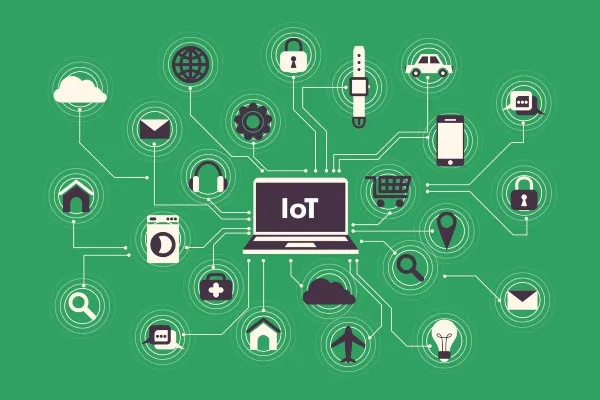
Think about all the smart objects you possess in your home—your home surveillance camera, smart oven, or fitness band. They don’t exist separately; they are talking to a cloud brain. They’re talking to it through a digital interpreter called an API (Application Programming Interface).
In the IoT age, these APIs are the digital gatekeepers that guard the communication interfaces of billions of remote devices and cloud-based resources, data stores, and mobile apps that manage them. Since IoT APIs will be public-facing, high-volume, and nominally process sensitive information (location, health, security status), their security is of utmost concern. A breach here isn’t merely a compromised server; it’s millions of physical devices hanging in the balance.
The IoT API Challenge: A New Type of Traffic
It’s much harder to secure an IoT backend API compared to securing an average website API for two reasons:
- Gigantic Scale: A single IoT platform is capable of controlling millions of devices all transmitting infinitesimal packets of data every few seconds. That is akin to APIs that must handle a record volume of low-bandwidth traffic, and it would be difficult for conventional rate-limiting.
- Heterogeneity and Longevity of Devices: IoT devices employ a multitude of protocols (not only plain old HTTP) and linger on for years, never getting patched. This creates a huge, heterogeneous attack surface that is hard to patch on a regular basis.
If an attacker compromises one of these foundation APIs, they expose the entire device set to attack and can use them as surveillance agents, DDoS bots, or gateways into the full home or corporate network.
The API Security Essential Toolbox
In order to protect these open interfaces, security teams depend on three fundamental pillars of defense:
1. Strong Authentication and Authorization
And that is the critical step: ensuring that only the right devices talk to the right services, and that they are who they claim to be.
- Zero Trust and Mutual TLS (mTLS): Instead of a username and password, IoT platforms generally employ Mutual Transport Layer Security (mTLS). That is, the device and the server both have to authenticate each other with cryptographically signed digital certificates before sending each other data. The device is presented with an ephemeral certificate, which is essentially un-counterfeitable.
- Token-Based Access: Instead of logged-in sessions, APIs use temporary access tokens (e.g., OAuth 2.0 or JWTs). If a stolen compromised token is obtained by an attacker, it will expire, limiting an attacker’s time of exposure.
- Least Privilege Principle: The air conditioning unit’s API is only permitted to give temperature information. It should never touch billing information. Any app and device gets the minimum number of access rights that it will use.
2. Input Validation and Protocol Filtering
APIs are there to accept and process data. Security dictates that they should examine all data passing through with laser-like accuracy.
- Aggressive Payload Validation: The API must validate aggressively what form of data it will accept. If a temperature sensor should return a reading between -20°C and 50°C, the API must reject categorically any request that includes the numeral “9000” or a piece of code that is malicious (one of the more common methods injection attacks are attempted with).
- MQTT/CoAP Protocol Hardening: MQTT is a lightweight protocol and common in IoT. Security framework should safeguard against such protocols being exploited. Preventing a device from subscribing beyond its own local purpose, for instance, prevents lateral movement across the network.
3. Monitoring, Rate Limiting, and Decommissioning
Regardless of what defenses are built, threats will be dynamic. Continuous monitoring as well as defined end-of-life processes must be in place.
- Anomaly Detection: Machine learning based monitoring systems look for abnormal behavior. When a single camera is trying 100 times within a minute to get connected, or devices from the same geographical location are starting to feed trash data, the system flags the activity as a probable DDoS attack or botnet intrusion.
- Hard Rate Limiting: Limits are placed on the number of requests a single device or an IP address may make within a given time interval. It drowns attacks by overwhelming resources and limits brute-force hacking attempts.
- Secure Decommissioning: Upon the retirement of an IoT device, its API keys and certificates must be immediately revoked and storage wiped securely. This is to prevent giving retired forgotten devices a chance to be compromised as passive entry points for the network.
In our networked world, the API is no longer a programming abstraction—it’s the digital border patrol. Putting API security first as the foundation of the IoT ecosystem means we get to ensure that the handy smart technology doesn’t come at the expense of our privacy and digital security.