

We love our IoT devices—the smart heaters, the factory monitors, the tiny health monitors. They make our existence perfect and infuse it with wisdom. But there is one concern that keeps security professionals awake at night: what if one of those hundreds of millions of devices has a gargantuan security flaw?
Before, you could leave your PC at the store to get fixed. With IoT, that’s not an option. The solution is Over-the-Air (OTA) Firmware Updates, basically permitting a digital handyman to fix your device via the web. But if the remote repair process itself isn’t absolutely secure, then it becomes the widest, biggest door for hackers.
A hijacked update is the ultimate cyberattack: an attacker can plant malware in the device’s innermost operating core, and if they do, they gain complete, quiet control.
The OTA Update: A Risk Worth Taking
OTA updates are necessitated by three reasons:
- Security Patches: Fixing newly found bugs (the “zero-day” vulnerabilities) that weren’t understood during production time.
- Bug Fixes: Functional fixes without the necessity of physical recall.
- Feature Extensions: Adding features that extend the value and lifetime of the device.
Making this convenience a secure lifeline is the challenge.
Designing the Tamper-Proof Patch Process
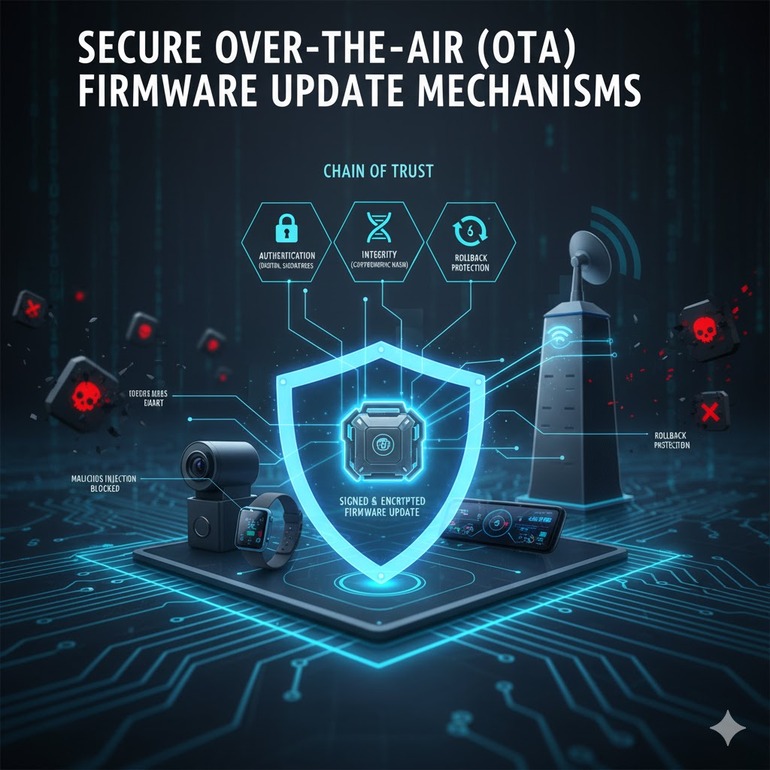
An OTA process must act as a high-security transaction, verifying every step in order not to let the update package be forged or tampered with. This must be achieved through creating a robust process that has three simple pillars:
1. Authentication and Trust (The Digital Passport)
Well before a device will accept a firmware package, it must thoroughly authenticate the sender and check the package integrity.
- Digital Signatures: The update file is digitally signed by the device maker with a private crypto key. The IoT device receives the update only if it can authenticate the signature with the associated public key securely embedded in its hardware. This prevents any attacking third party from distributing evil firmware.
- Root of Trust (RoT): The board must contain a hardware-based, immutable Root of Trust—a secure place for the master cryptographic keys to reside. The root element guarantees that the verification process cannot be altered.
2. Encryption and Integrity (The Sealed Envelope)
The firmware package must be encrypted for shipping across the network and storage on the device.
- Safe Transportation: The patch is securely carried across channels like TLS/SSL to protect it from interception and modification during transport.
- Verifies Integrity: When it arrives at the device, it performs a checksum or a hash check on the update package. If one bit of information was changed (by accident due to a network glitch or by someone maliciously), the hash will not match the signature, and the update is refused.
3. Resilience and Rollback (The Safety Net)
What if the legitimate, signed update contains a show-stopping bug that bricks the device? A solid OTA system will need a recovery plan.
- Dual-Bank Memory: The majority of secure IoT devices have a dual-bank memory, that is, two banks of memory: one holding the active firmware and the other holding the new firmware. The new code is kept secret until verification has successfully been done. In case of a failed boot when switching over, it automatically reverts back to the last good known firmware on the alternative bank.
- Atomic Updates: The transition from the two must be “atomic,” either completely and successfully, or to roll back completely to the original position. This prevents the device from being left in an unusable, half-updated condition.
Beyond the Device: Securing the Backend
The secure OTA procedure is not only for the device, but it also relies heavily on the backend infrastructure of the manufacturer. The server infrastructure that generates, signs, and deploys the firmware must be protected with maximum operational security. The instant an attacker gets hold of the manufacturer’s private signing key, the whole device fleet can be brought down by “legitimate-looking” malicious updates.
Secure OTA updates are non-negotiable for the IoT future. They take a geographically dispersed, vulnerable device fleet and turn it into a manageable, defensible network. To manufacturers, such infrastructure is not an amenity but a promise of customer security and product longevity.