

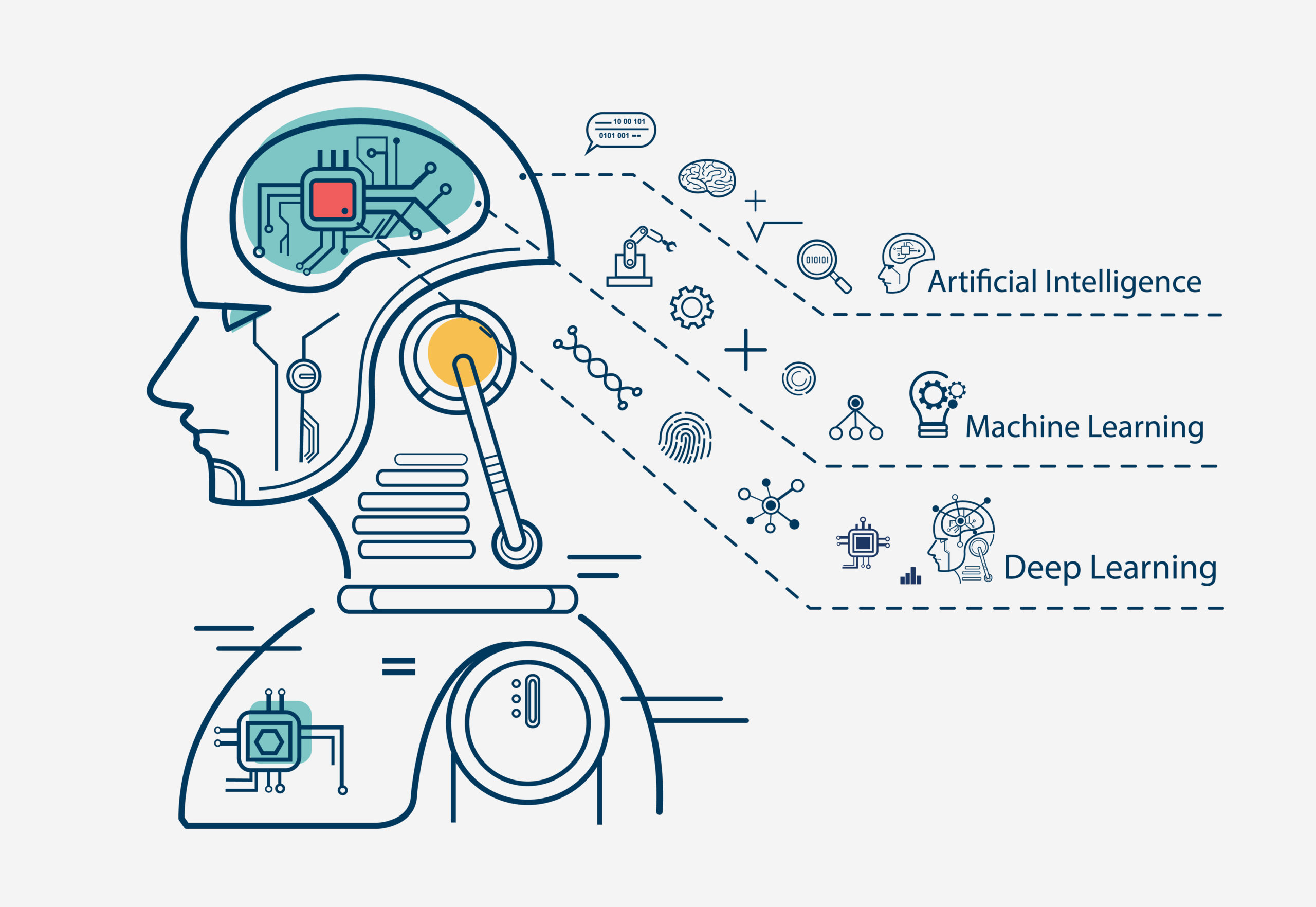
As of now, it is still an open problem to extract useful knowledge from immense amounts of data with scarce labeled data or at high costs of procurement. Unsupervised and semi-supervised learning are the most crucial approaches in big data analytics, by which unknown patterns, forms, and associations can be learned using minimal utilization of labeled sets.
Unsupervised Learning: Discovering Data Without Labels
Unsupervised learning algorithms take unlabeled input data and infer the inherent patterns and structures. The aim is to understand the structure of the data, to group similar data points, or to reduce dimensionality to visualize and understand it easily.
Some of the standard unsupervised learning methods are:
- Clustering: Separates data points into clusters or groups using similarity measurements. Applications include customer segmentation, outlier detection, and document clustering.
- Dimensionality Reduction: Methods like Principal Component Analysis (PCA) reduce feature numbers while preserving variance for effective downstream analysis.
- Association Rule Learning: Identifies variable relationships, which may be useful in market basket analysis.
Unsupervised learning is useful most in cases where there is little or no labeled data available, using data’s intrinsic properties to guide analysis.
Semi-Supervised Learning: Merging Labeled and Unlabeled Data
Semi-supervised learning blends the tools of supervised and unsupervised learning, using a small quantity of labeled instances with a huge quantity of unlabeled instances. It is particularly useful when labels are expensive or time-consuming to obtain, but there is ample quantity of unlabeled data available.
The model can normally be pre-trained on the labeled examples and later refine itself incrementally by pseudo-labeling the unlabeled examples. The most widely used methods are self-training, co-training, and graph-based approaches.
This semi-supervised hybrid method provides improved model accuracy and generalization than supervised models in small sizes of labeled data and more feasible than labeling large datasets entirely.
Applications in Big Data Analytics
- Customer Analytics: Unsupervised clustering of customers improves targeted marketing without any pre-specified clusters.
- Fraud Detection: Semi-supervised models detect fraud by learning typical patterns from a small set of labeled instances of fraud.
- Healthcare: Leveraging abundant unlabeled medical image data with smaller sized labeled sets of data improves disease diagnosis.
- Natural Language Processing: Semi-supervised learning improves language models where the labeled corpora may be small.
- Industrial IoT: Identifying outlier behavior or predictive maintenance requirements using unsupervised monitoring of sensor data.
Challenges and Future Directions
Challenges include also finding relevant algorithms for noisy, complicated big data, scaling up compute, managing class-imbalanced data distribution, and model accuracy in cases where many labels aren’t available.
Upcoming new trends are everything about model explainability, development of automated labeling methods, and improvement of hybrid models to have improved leverage of unlabeled data. Architectural innovations in deep learning also propel innovation in unsupervised and semi-supervised learning capabilities.
Conclusion
Unsupervised and semi-supervised learning methods are central to the liberation of big data potential to support analytics and render it understandable when labeled data is not available. With pattern discovery and ensuring ease of learning with reduced supervision, these methods enable organizations in whatever forms to attain actionable intelligence, automate, and innovate in the data-centric 2025 and beyond.